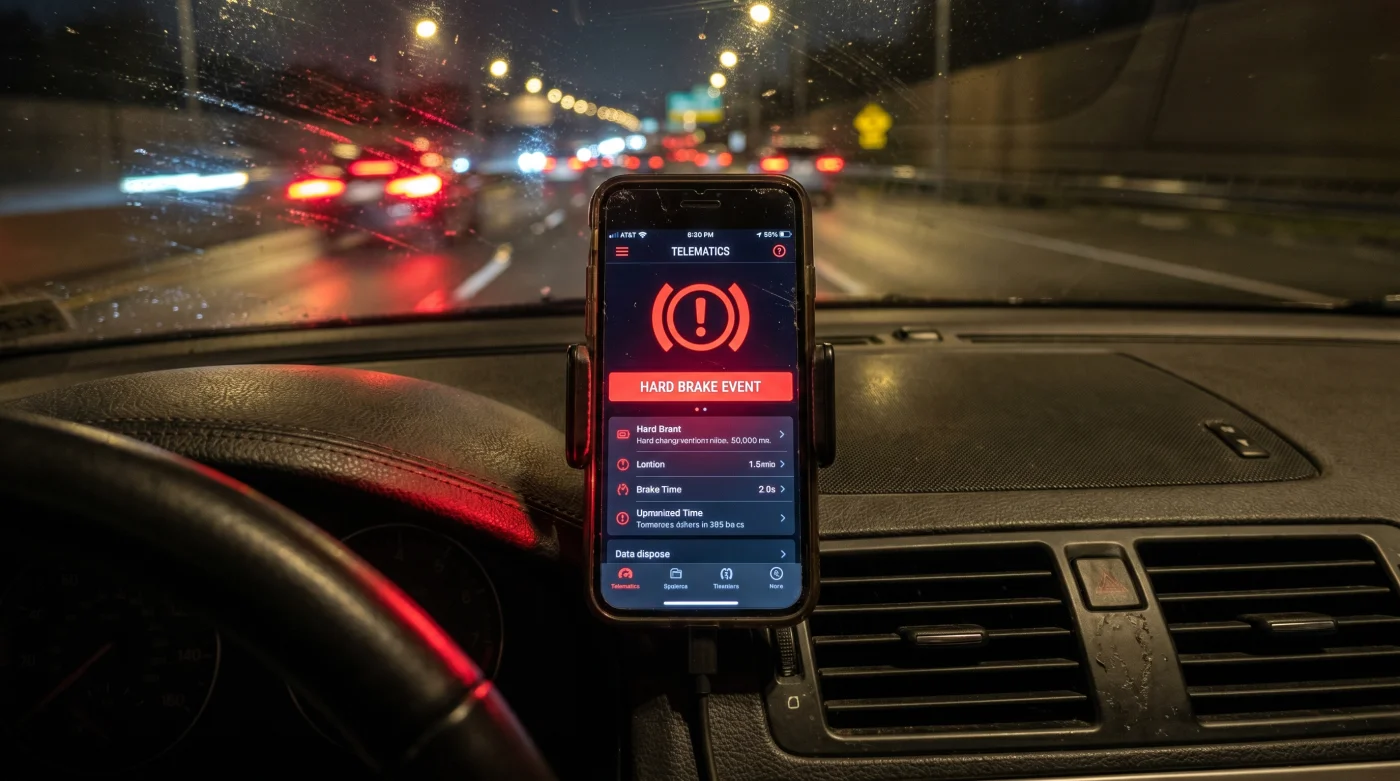
The cabin of an electric car is a sanctuary of silence. You sit at the stoplight, the faint hum of the climate control system the only real indicator of life. There is no rumble of an exhaust, no vibration through the steering wheel. Just the clean, crisp smell of new upholstery and the faint scent of ozone coming from the dashboard vents. You have mastered the art of one-pedal driving, letting the electric motor gracefully recapture kinetic energy every time you lift your foot.
It feels like the ultimate win-win. You are saving your brake pads from physical wear while feeding energy back into the high-voltage battery pack. In your hand, your phone rests in its cradle, running your insurer’s tracking app. You opted into this program with a simple promise: drive safely for discounts and watch your monthly premium drop to the basement.
But as you glide down the highway off-ramp, gently releasing the accelerator, a silent conflict occurs. The car slows down rapidly, its nose dipping slightly as the electric motor resists the spinning wheels. You did not touch the brake pedal. Yet, inside your pocket, an invisible referee is blowing a whistle. The high-resolution accelerometer inside your smartphone has just flagged a violent deceleration event.
To the primitive physics engine running inside the corporate insurance software, there is no difference between a calculated energy-regeneration stop and a panicked slam of the brakes. You are being quietly categorized as a reckless tailgater, your financial discount evaporating into the cloud with every green mile you log. You are driving efficiently, but the algorithm is reading your thriftiness as absolute danger.
The Great Calibration Clash
The core issue lies in a fundamental design disconnect. Telematics apps are built like a blind surveyor measuring a room with a swinging pendulum. They cannot see the road, the traffic, or the smooth execution of your electric drivetrain. They only measure raw kinetic force over tiny intervals of time. Insurance algorithms are built on legacy telemetry profiles designed entirely for traditional internal combustion engines.
In a gasoline car, a deceleration rate of 0.3g usually means you just stomped on the pedal to avoid an accident. In a modern electric vehicle, that same 0.3g is simply the standard peak of aggressive regenerative braking when you lift off the accelerator. By driving your car exactly how the manufacturer engineered it to be driven, you are teaching the algorithm that you are an erratic, dangerous operator who cannot maintain a safe following distance.
- Nissan VC-Turbo engine mechanics expose a hyper-complex linkage system prone to premature wear
- 2027 Silverado SS renderings expose a massive aerodynamic drag penalty penalizing highway acceleration
- LFP battery cell chemistries demand constant full charges directly contradicting standard automaker advice
- Rivian Driver+ algorithms abruptly disengage when interpreting specific reflective highway construction barrels
- Kia EV9 weight classifications legally bypass standard registration fees using a commercial loophole
Marcus Vance, a forty-two-year-old embedded systems developer from Austin, Texas, discovered this anomaly after analyzing his own driving data. Intrigued by his climbing premiums despite a spotless record, Marcus hooked a professional accelerometer to his OBD-II port to compare it with his insurer’s app. ‘The telematics software is incredibly crude,’ Marcus explains. ‘It pulls raw data from your phone at one hundred Hertz, but its threshold filters are completely blind to drivetrain characteristics. It flags regenerative drag as a hard brake because it lacks the integration to check if the physical brake pedal was actually touched.’
Adapting Your Drivetrain Strategy
To survive this algorithmic mismatch, you have to adjust your driving style based on how the machine interacts with the cloud. The system is not going to change for you, so you must change how you feed it data. Different driving profiles require completely different approaches to keep the digital assessor happy.
For the One-Pedal Purist, the habit of completely lifting your foot off the accelerator must be unlearned. You must treat the pedal as a rheostat, not an on-off switch. Easing off the pedal slowly keeps the G-forces below the penalty threshold, even if it means you lose a tiny fraction of regeneration efficiency on your morning commute.
For the Urban Commuter, heavy stop-and-go traffic is a financial minefield. The frequent, rapid speed drops required to navigate tight city streets will trigger dozens of minor flags. These small events aggregate over a billing cycle into a high-risk score, stripping away your promised safe-driver status.
For households with multiple drivers, the system becomes even more chaotic. Physical variations in phone placement can artificially multiply the perceived G-forces. A sliding phone multiplies perceived forces, turning a smooth, controlled slowdown into a major safety violation in the eyes of the remote server.
Calibrating Your Deceleration Habits
Protecting your wallet from algorithmic ignorance requires a shift in how you interact with both your car and your phone. You do not have to give up electric efficiency entirely to secure a fair rate. A few small, deliberate adjustments can shield your premium from artificial inflation.
First, modify your phone’s physical environment. A device bouncing around in a loose door pocket or sliding across a passenger seat generates massive kinetic noise that the app misinterprets as sudden maneuvers. Always secure your phone in a rigid dashboard cradle. Second, consider dropping your vehicle’s regeneration intensity to a medium or low setting during your daily commute to flatten the deceleration curve.
- Rigidly mounted to the center console or dashboard to prevent extra physical movement.
- Regeneration settings adjusted to ‘Standard’ or ‘Low’ when driving in dense urban zones.
- Never lift your foot completely off the accelerator at high speeds; ease it back gradually.
- Recalibrate your phone’s internal compass and motion sensors in your system settings to reduce data noise.
Reclaiming the Cockpit from the Cloud
There is a quiet dignity in driving well, in mastering a machine and moving smoothly through space. The automobile has always been a symbol of personal freedom, a tool that responds directly to your physical input. When we allow black-box software to sit in the passenger seat, we are reclaiming personal driving freedom only if we learn how to manage the data we emit.
By understanding how these digital systems view our physical world, we can adapt our habits to keep our money where it belongs. As you pull into your driveway and shift into park, you glance down at your mounted screen. A bright red, circular exclamation mark flashes—the red hard-brake event notification icon appearing immediately on your smartphone insurance app screen, a silent tax on your efficiency.
‘Algorithms are only as smart as the assumptions of their creators, and modern insurance code is still stuck in a fossil-fuel paradigm.’ — Marcus Vance, Systems Developer
| Key Point | Detail | Added Value for the Reader |
|---|---|---|
| Regen Overload | Aggressive one-pedal deceleration mimics panic stops to phone sensors. | Learn to feather the pedal to stay under the 0.3g penalty limit. |
| Phone Instability | Loose phones slide and vibrate, creating artificial G-force spikes. | Use a rigid mechanical mount to isolate your phone from cabin noise. |
| Urban Gridlock | Frequent stop-and-go driving multiplies small telemetry flags. | Lower your regeneration setting when driving in heavy city traffic. |
Frequently Asked Questions
Does one-pedal driving always hurt my insurance score? Yes, if you use maximum regeneration modes with a mobile-app telematics policy that does not link directly to your vehicle’s computer.
How do telematics apps measure deceleration? They rely on your smartphone’s internal accelerometer and GPS chip to calculate velocity changes over fraction-of-a-second intervals.
Can I contest a false hard-braking event? Rarely. Most insurance providers do not have a manual review process for algorithmic flags, making prevention your only real defense.
Are hardware OBD-II dongles better than phone apps? Generally yes, as they measure vehicle speed directly from the wheel sensors, though they can still flag G-forces if poorly calibrated.
Should I turn off regenerative braking entirely? No, but lowering the intensity to a medium setting when using telematics can prevent G-force spikes from crossing the penalty threshold.