The smell of aerosol degreaser and cold damp concrete always clings to a workshop in the early hours of November. Outside, the rain drizzles against the metal roof, but inside, the focus is entirely on the undercarriage of a pristine, third-generation Toyota Tacoma TRD. Under the bright shop lights, the golden-yellow casing of the factory-upgraded suspension shines like a promise. It looks like a machine built to conquer the worst washboards and rocky passes without flinching.
Yet, as you peer past the heavy-duty skid plates and trace the steering assembly, a different story emerges. The factory engineers designed a beautiful truck, but they had to make compromises for weight and assembly-line efficiency. When you turn the wheel, you aren’t just directing a pair of tires; you are **commanding a massive system** of levers and rotational energy that fights back against the frame.
Underneath the glossy marketing, the steering rack housing is made of cast aluminum, secured to the steel crossmember by rubber-bushed brackets. As soon as you step up to larger off-road rubber, every rock shelf and deep rut acts like a giant pry bar. The factory mounts begin to stretch, allowing the entire steering assembly to twist and shift under load. This subtle movement is the silent precursor to a catastrophic trail failure.
The Leverage Trap: Why Factory Specs Stop Short
To understand why this happens, you have to think of your front tires as heavy pendulums. When you install a premium TRD suspension package, you are inviting yourself to go faster over rougher ground. However, the rotational mass of those beefy tires creates a tremendous amount of leverage against the steering rack. **Physics is entirely unsentimental** about factory warranties; when a heavy tire binds against a rock, that kinetic energy has to go somewhere.
Instead of the steering shaft turning the wheels, the wheels end up twisting the entire aluminum steering rack housing. It is like trying to write a letter while someone gently shakes your wrist. Over time, this constant twisting fatigues the soft aluminum ears of the rack housing. An aftermarket reinforcement bracket acts as a rigid splint, wrapping around the weak points to ensure that all your steering inputs go directly to the dirt, not into flexing metal.
- Telematics tracking apps secretly penalize manual transmission downshifting as aggressive braking events
- Mercedes electric G-Wagon tank turn capability silently shreds expensive factory tire tread
- 2027 Nissan Z redesign details leak a heavier hybrid drivetrain ruining track balance
- Ford NACS adapters secretly throttle maximum charging speeds to protect older battery architectures
- Super Cruise mapping software aggressively phantom brakes near specific active logging routes
A Shared Secret from the High Desert
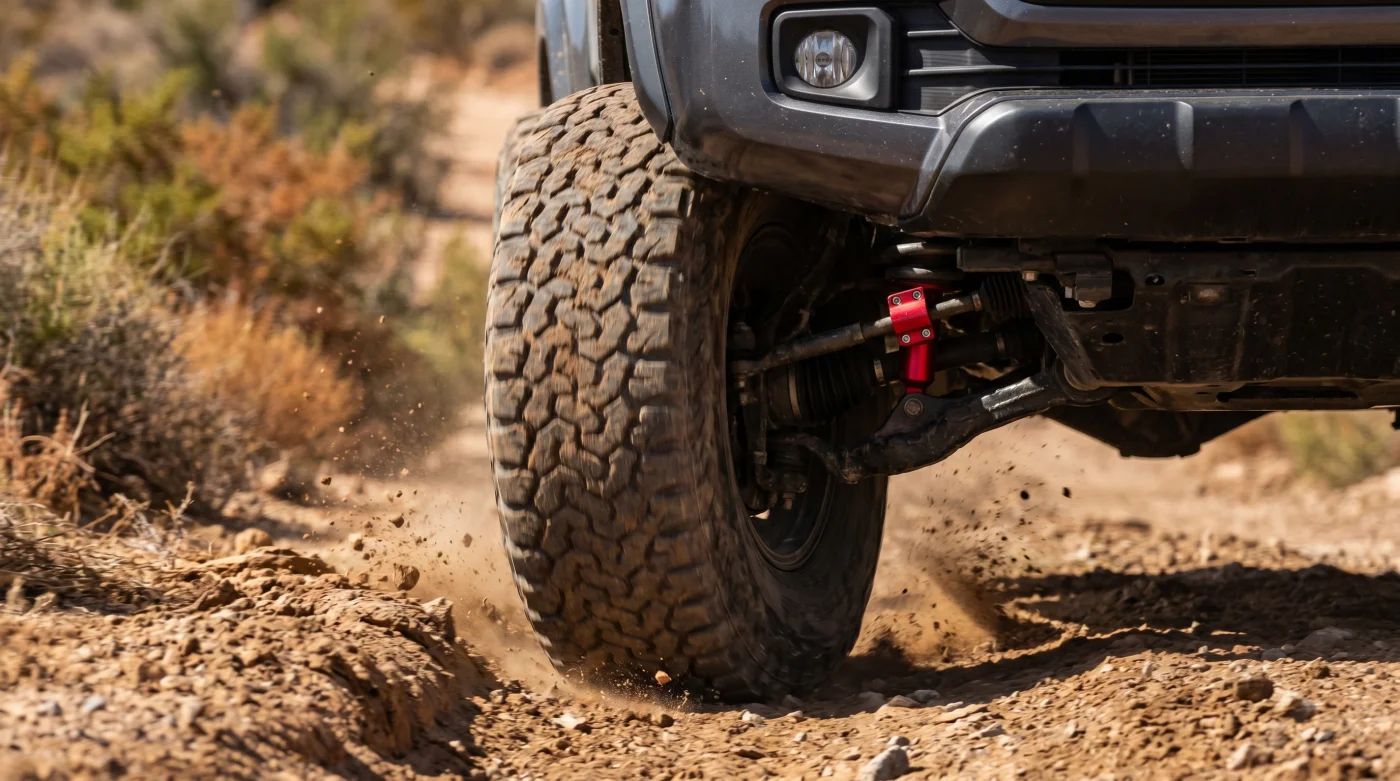
Marcus Vance, a forty-four-year-old suspension fabricator based out of Bend, Oregon, has seen this play out dozens of times on the rugged trails of the Pacific Northwest. He recalls a customer who brought in a brand-new Tacoma with less than five thousand miles on the odometer, already suffering from a **mysterious front-end wander**. “The owner thought his alignment was out,” Marcus says, shaking his head. “But when we put it on the rack and had him wiggle the steering wheel, you could see the whole passenger-side steering rack housing bowing nearly a quarter of an inch. We bolted on a bright red anodized aluminum clamp over that greasy steel steering shaft, and the truck immediately tracked straight as an arrow.”
Tailoring the Fix: Finding Your Rig’s Sweet Spot
Not every Tacoma is built for the same purpose, and your approach to bracing the steering system should match how you actually use your truck.
- The Weekend Trail Raider: If you primarily use your truck for light camping, fire roads, and occasional moderate obstacles with tires under 33 inches, a lightweight single-bolt reinforcement clamp is sufficient. This provides just enough resistance to prevent the rubber bushings from degrading prematurely.
- The Heavy-Haul Overlander: For rigs carrying heavy steel bumpers, winches, roof-top tents, and rolling on 35-inch mud terrains, a full-billet, dual-clamp reinforcement system is non-negotiable. **This setup locks the rack** to the frame crossmember, absorbing the massive lateral forces generated when crawling over off-camber obstacles.
Installing the Shield: A Mindful Saturday Project
Installing a steering rack reinforcement bracket is an excellent way to connect with your vehicle. It is a straightforward, satisfying job that requires minimal tools but yields massive peace of mind. Work slowly, clean the mounting surfaces thoroughly, and ensure the vehicle is safely supported on jack stands before crawling underneath.
- Spray the factory passenger-side steering rack mounting bolts with penetrating oil and let them soak for ten minutes.
- Remove the factory steel retaining strap, taking care **not to damage the** soft rubber bushing underneath.
- Clean the greasy steel steering shaft housing with a lint-free rag and a mild degreaser to ensure a metal-on-metal grip.
- Position the new anodized aluminum clamp over the housing, ensuring it seats perfectly square against the crossmember.
- Apply blue threadlocking compound to the new high-tensile fasteners before threading them in by hand.
- Torque the bolts in an **alternating pattern to thirty-five** foot-pounds to distribute the clamping force evenly.
Tactical Toolkit:
• 14mm and 17mm deep-well sockets
• High-quality torque wrench
• Blue threadlocker (medium strength)
• Brake cleaner and shop towels
• Heavy-duty jack stands
The Quiet Confidence of Mechanical Balance
There is a unique satisfaction that comes from addressing a mechanical vulnerability before it addresses you on a remote mountain pass. When you beef up your suspension, you are increasing the capability of your truck, but you must also balance that capability down the line. Installing a simple, beautifully machined piece of aluminum ensures that your steering remains precise and reliable, no matter how hard you push the limits. It turns your Tacoma from a capable consumer vehicle into an enduring, rugged tool built for the long haul.
“True mechanical empathy is not just about changing your oil; it is about reinforcing the quiet links that bear the silent, heavy burdens of your ambition.” – Marcus Vance
| Key Point | Detail | Added Value for the Reader |
|---|---|---|
| Aluminum Flex | Factory housing twists under the leverage of larger tires. | Prevents catastrophic housing cracks on the trail. |
| Reinforcement Clamp | Billet aluminum bracket that secures the rack to the frame. | Restores steering precision and stops lane-drifting. |
| Installation Time | A simple 45-minute garage project with basic hand tools. | Saves hundreds in labor and future steering rack replacements. |
Frequently Asked Questions
Will this bracket affect my factory alignment? No, the bracket simply clamps and supports the rack housing in its factory position without altering steering geometry.
Can I install this on a completely stock Tacoma? Yes, even on stock tires, it reduces steering play and prolongs the life of the rubber bushings.
What color options are available? Most manufacturers offer anodized red, black, or clear finishes to protect against road salt and grime.
Does this modification void my factory warranty? Under US law, a dealer must prove the aftermarket bracket caused a failure to deny warranty coverage on a related part.
Do I need to lift the truck to install it? While not strictly necessary, lifting the front end and placing it on jack stands gives you much better access and leverage.