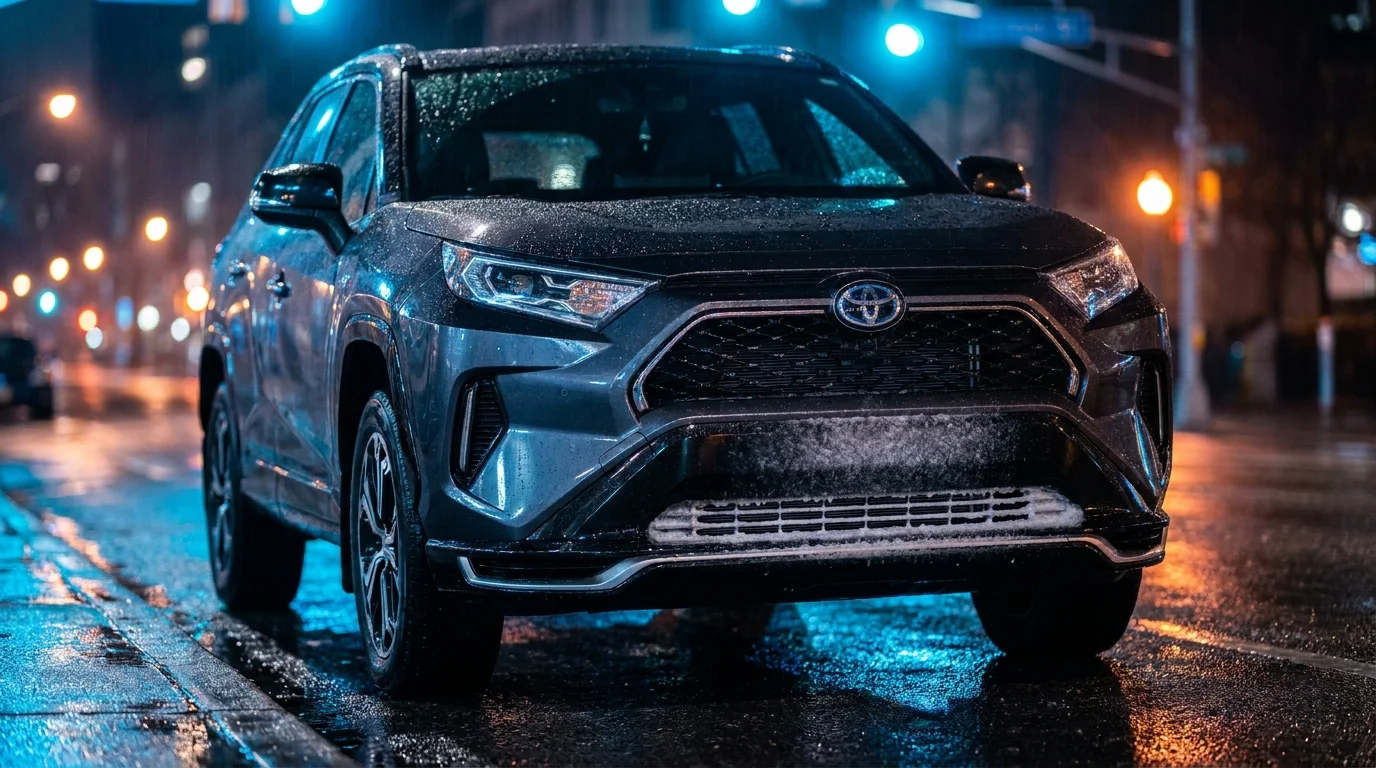
Imagine stepping out into a pre-dawn Minnesota morning, the temperature hovering at a bitter seven degrees Fahrenheit. The air is so cold it feels like breathing through a pillow, dry and sharp enough to sting your nostrils. You look at your driveway where a sleek, modern battery-electric vehicle sits plugged into its wall box. Beside it rests a Toyota RAV4 Prime, its nose wearing a thin glaze of rime.
If you climb into the pure electric vehicle, a silent battle begins. The cabin heater immediately starts pulling massive energy from the high-voltage pack to warm the interior air. Underneath the car, the thermal management loop struggles to keep the battery cells from freezing, using up precious electrons just to stay alive. The range estimator on the dashboard drops by thirty percent before you even back down the driveway.
Now look closer at the front grille of the RAV4 Prime, behind which sit the frosted aluminum heat exchanger fins. These delicate metal ribbons look fragile under their layer of winter ice, but they are the gateway to a remarkably sophisticated thermal scavenger hunt. Instead of relying on raw, brute-force electrical resistance to keep you warm, this machine treats cold weather as a puzzle to be solved mechanically.
The contrast is stark between the fragile illusion of pure electric efficiency in winter and the clever engineering of a plug-in hybrid that refuses to starve its battery for the sake of your comfort. While the EV world scrambles to build bigger batteries to cushion the winter range drop, Toyota took a different path, treating heat not as a waste product to discard, but as a precious currency to be hoarded and redirected. By refusing to give up the internal combustion engine entirely, they created a system where frosted aluminum heat exchanger fins work in harmony with liquid coolant loops to bypass the worst of winter’s energy drains.
The Perspective Shift: The Thermodynamics of the Scavenger
To understand this car, you have to stop thinking of a hybrid as a compromised step toward a pure electric future. Instead, think of it as a thermodynamic sponge. The RAV4 Prime uses a highly specialized heat pump system, but unlike the basic setups found in early EVs, this one operates on a closed-loop scavenging principle.
When you drive a full EV in sub-zero weather, the vehicle must choose between keeping its battery warm and keeping you warm. It is a zero-sum game played with chemistry. The Prime, however, turns this dynamic on its head by utilizing three distinct heat sources: the ambient air, the electric motors, and, when absolutely necessary, the thermal reservoir of its internal combustion engine. The car plays chess with temperature, shifting energy between these reservoirs so smoothly that you never feel the transition.
- Genesis G80 used pricing exposes a massive flagship luxury discount reality
- Subaru Outback Onyx Edition hides the exact heavy transmission cooler Wilderness owners demand
- AMG GLS 63 2027 leaks expose a highly restricted hybrid twin turbo architecture
- Chevy Corvette C4 structural archives reveal a massive fiberglass torsional rigidity flaw
- Tesla Model 3 stalkless steering wheels create a massive tactile hazard during roundabouts
Marcus Vance, a forty-six-year-old thermal systems analyst based in Duluth, spent three winters tracking the real-world efficiency of various commuter vehicles. He observed that while his neighbor’s high-end electric sedan lost nearly forty-two percent of its usable range during the January freeze, his own Prime retained almost eighty-five percent of its practical utility. Marcus notes that the secret lies in how the vehicle scavenges low-grade heat from the power electronics, passing it through the cabin condenser before the engine ever needs to turn over.
Tailoring the Cold-Weather Ride
The Short-Range Commuter
If your daily drive is under thirty miles, you can run entirely on electricity without ever waking the gasoline engine, even in freezing weather. The heat pump works down to fourteen degrees Fahrenheit by squeezing warmth out of the freezing outdoor air. You bypass the gas pump entirely while enjoying a cabin that warms up faster than a traditional luxury sedan.
The Sub-Zero Highway Cruiser
When the temperature drops into the negatives, the vehicle automatically adjusts its strategy. The 2.5-liter engine fires up, not just to turn the wheels, but to act as a highly efficient furnace. The heat generated by combustion is routed through the coolant lines to warm both the cabin and the large hybrid battery pack, saving the electricity for when you exit the highway.
The High-Mountain Weekender
For those who head into the mountains where charging infrastructure is non-existent and the air is thin, the mechanical redundancy shines. The mechanical security of dual powerplants ensures that even if a charging station is buried under six feet of snow, your cabin remains a safe, warm sanctuary without any risk of getting stranded.
Mindful Application: Maximizing Winter Efficiency
Getting the most out of this thermal architecture requires a few simple, intentional adjustments to your morning routine. You do not need to be a mechanical engineer to make the system work for you; you just need to work with the car’s natural logic.
Use these steps to optimize your winter range and keep the cabin comfortable:
- Plug in the vehicle at least two hours before departure to allow the battery heater to run off grid power.
- Activate the cabin pre-conditioning via the app while the car is still connected to your charger.
- Keep the seat and steering wheel heaters on, as they transfer warmth directly to your body much more efficiently than blowing hot air.
- Use the “HV” mode on highway stretches to let the engine generate cabin heat, saving your “EV” battery charge for slow city streets.
By preparing the vehicle while it is still tethered to the grid, you preserve the chemical energy stored in the battery. This ensures that when you unplug, every single kilowatt-hour goes toward moving you forward down the road rather than melting the frost off your windshield. Here is your Tactical Winter Toolkit for peak performance:
- Ideal Pre-Condition Time: 20 minutes before departure.
- Optimal Cabin Setting: 68 degrees Fahrenheit on “Auto” mode.
- Tire Pressure Adjustment: Add 2 PSI in winter to compensate for cold-weather air contraction.
The Bigger Picture: A Quiet Victory Over the Elements
In our rush to embrace a fully electric future, we often forget that nature operates on strict physical laws that do not care about marketing promises. The winter range anxiety that plagues pure EV drivers is not a software bug; it is a fundamental property of battery chemistry in the cold. By choosing a vehicle that respects these physical limits rather than ignoring them, you find a different kind of peace of mind.
There is a quiet satisfaction in knowing that your car is not fighting the cold, but working with it. As you watch the frosted aluminum fins do their silent work, you realize that true sustainability is not about choosing the loudest technology, but the one that actually works when the world freezes over.
“True engineering wisdom isn’t about ignoring the laws of thermodynamics; it’s about making them work in your favor when the mercury drops.” — Marcus Vance, Thermal Systems Analyst
| Key Point | Detail | Added Value for the Reader |
|---|---|---|
| Heat Scavenging | Uses waste heat from motor, inverter, and engine | Retains up to 85% range in sub-zero weather |
| Cabin Warm-up | Near-instant heat via engine coolant or pump | Superior physical comfort without range sacrifice |
| Redundancy | Dual powertrains ensure continuous heating | Total peace of mind during remote winter trips |
Frequently Asked Questions
Does the RAV4 Prime engine run in winter even in EV mode? Yes, if the temperature drops below 14 degrees Fahrenheit, the engine may cycle on briefly to generate cabin heat and protect the battery.
How much range does the RAV4 Prime lose in freezing weather? While a pure EV can lose up to 40% of its range, the RAV4 Prime typically experiences only a 15% to 20% drop when utilizing its hybrid thermal path.
Is the heat pump noisy during cold mornings? You might hear a mild hum from the front grille as the heat pump works, but it is significantly quieter than a traditional gas engine warming up.
Can I pre-warm the car without it being plugged in? Yes, but doing so will draw energy directly from the hybrid battery, which reduces your electric-only driving range for that trip.
Do frosted heat exchanger fins affect cabin heating? No, the system automatically runs a brief defrost cycle to keep the aluminum fins clear of ice, ensuring continuous heat exchange.