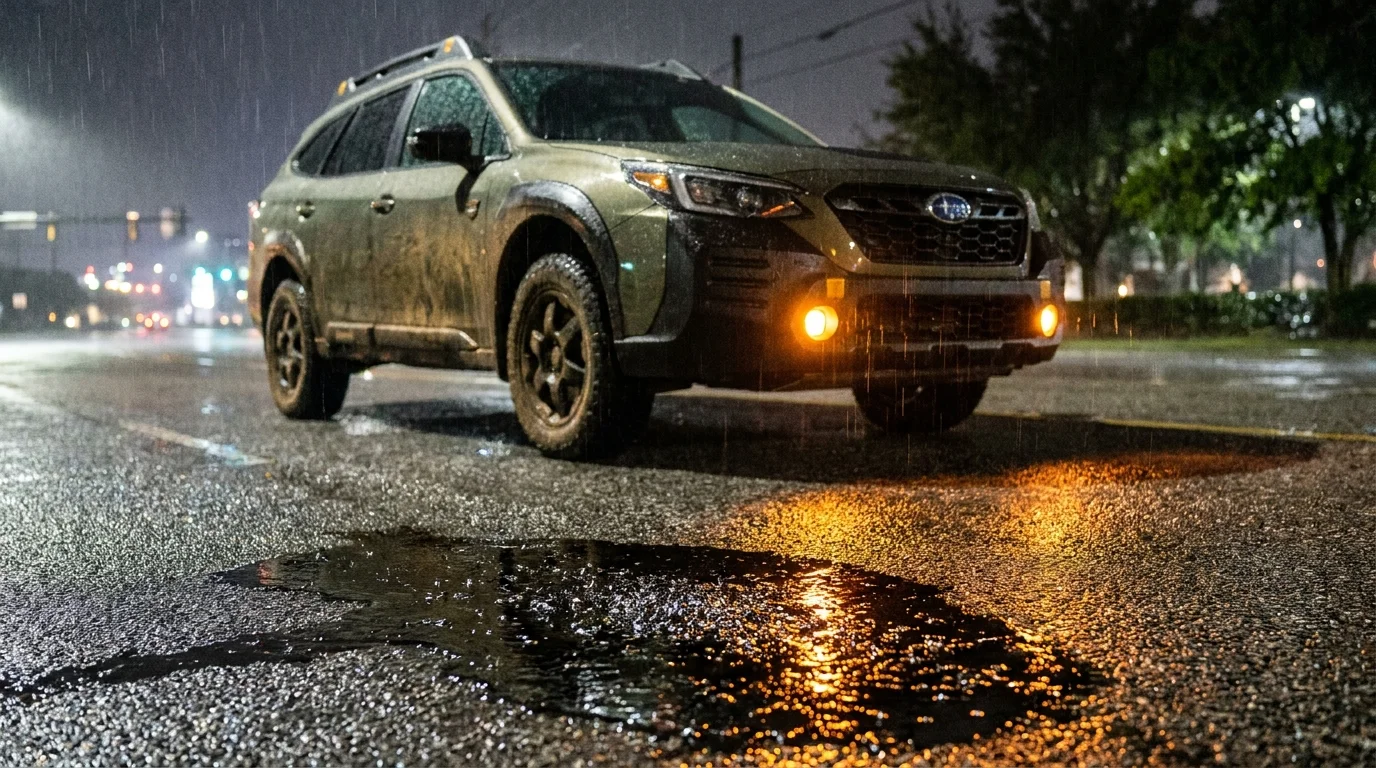
Morning in the Cascade Mountains arrives with a heavy scent of damp cedar and cold, wet pine needles. You walk out to your driveway, your boots crunching lightly on the gravel, and look at the rugged silhouette of your adventure wagon. With its lifted stance and copper accents, it looks entirely at home against the mountain backdrop, a machine designed to conquer the elements without breaking a sweat.
You push the start button, and the engine settles into its warm-up idle. As you pull onto the asphalt, a faint, high-frequency hum begins to register. It doesn’t sound broken; it sounds like a quiet electrical buzz or perhaps the roof rack catching the crosswinds. You ignore the soft whistle, thinking it is just the rugged nature of your machine letting you know it is working.
But as the odometer ticks past that crucial 40,000-mile mark, that whisper grows teeth. It transitions from an aerodynamic hum into a mechanical whine, especially when climbing moderate hills. This is not the tires singing; it is the sound of a system under quiet, destructive stress. Most owners mistake it for typical wind noise or off-road tire growl, completely missing the mechanical cry for help happening beneath their feet.
The modern marketing machine has convinced us that a lifted wagon is an unstoppable off-road tank. In reality, the mechanical heart of this machine relies on a delicate dance of friction and hydraulic pressure that cannot withstand endless uphill punishment without eventually paying a steep price. When you force this vehicle to scale steep trails week after week, you are quietly pushing its unique transmission to its absolute physical limits.
The Illusion of the Mountain Armor
To understand why this happens, you have to abandon the old idea of heavy steel gears locking together. Instead, think of your transmission as a highly strung violin string tuned just a fraction of a turn too tight. The Lineartronic CVT relies on a heavy steel chain sliding along smooth, cone-shaped pulleys. When you conquer steep mountain passes, the transmission logic forces these pulleys together with immense pressure to prevent slipping.
Over time, this constant high-torque clamping acts like a slow, rhythmic stretching machine. The steel links do not break, but they develop tiny micro-gaps, stretching the belt’s overall length by fractions of a millimeter. Once that belt loses its factory-spec tension, it begins to slip ever so slightly against the pulley faces, creating a high-frequency vibration that your ears register as a low-level whine.
- 2026 Rivian R2 highway tests expose surprisingly rigid suspension dynamics over broken pavement
- Honda CR-V air conditioning failures often require a five dollar relay instead of compressors
- BMW X5 values plummet when owners install generic battery replacements without system registration
- Ford F-150 EcoBoost longevity absolutely demands completely ignoring the factory oil change intervals
- Costco Auto Program completely shields buyers from the most aggressive dealership finance tactics
Take a walk through the garage of Marcus Vance, a 44-year-old transmission specialist in Denver, Colorado. On any given Tuesday, Marcus has at least one modern overland vehicle on his lift, its belly pan removed and its diagnostic ports wired up. “The Wilderness trim gives drivers the confidence to climb fire roads that would make a mountain goat think twice,” Marcus explains while wiping his grease-stained hands. “But while the suspension can handle the rocks, the CVT fluid is boiling inside its cooler, silently cooking the very additives designed to keep that steel belt from carving grooves into the pulleys.”
Decoding the Wilderness Profiles
The High-Altitude Explorer
If you regularly load your roof rack with heavy tents and head straight for alpine passes, your vehicle spends hours in a high-load, low-speed state. This is the absolute worst-case scenario for a CVT because it lacks the cooling airflow of highway driving. Your transmission fluid temperatures skyrocket quickly, accelerating the breakdown of protective lubricants.
The Dirt-Road Cruiser
For those who use the extra ground clearance primarily for rutted dirt roads and winter commutes, the threat is slower but still present. The constant micro-slips on loose gravel trigger rapid adjustments in the pulley system, causing wear that slowly accumulates over tens of thousands of miles.
Even if your daily drive is mostly flat asphalt, the aggressive Wilderness tuning keeps the engine in its torque band longer, placing continuous tension on belt even during mundane grocery runs. The transmission is constantly working harder, meaning the 40,000-mile mark is often where the first symptoms of physical fatigue finally make themselves heard.
The Forty-Thousand-Mile Diagnostic Ritual
Protecting your machine requires moving past the standard factory maintenance schedule, which often labels transmission fluid as a “lifetime” component. If you plan to keep your vehicle past its warranty, you must adopt an active, hands-on diagnostic routine to catch wear before it turns into a catastrophic failure.
To catch the damage before it requires a five-thousand-dollar replacement, you need to listen to your car when it is cold and under load. Here is the physical inspection protocol you should perform every autumn:
- Monitor transmission pan temperatures using an OBD-II scanner during steep climbs; anything consistently over 220°F requires immediate attention.
- Perform a fluid color check by drawing a small sample from the fill plug; fresh fluid is a light green-amber, while compromised fluid turns a dark, burnt brown.
- Listen for a pitch change when transitioning from coasting to light acceleration between 30 and 45 miles per hour.
- Inspect the auxiliary transmission cooler lines for weeping or damp spots that indicate pressure-induced leaks.
By treating these inspections as a necessary ritual rather than a chore, you gain a clear picture of how your driving style is affecting the metal components deep inside the car’s belly. This proactive care is the only way to guarantee longevity on the trail.
Tactical Toolkit:
- OBD-II Monitor (for real-time temperature tracking)
- Sample Syringe (for pulling fluid from the fill plug)
- Infrared Thermometer (to check auxiliary cooler efficiency)
Reclaiming the Trail on Real Terms
There is a quiet satisfaction in knowing the true limits of your machine. The Wilderness is an exceptional tool for reaching the remote edges of the map, but it is not a mindless appliance that can be abused without consequence. True mechanical empathy means understanding that every steep climb demands a small, invisible sacrifice from the steel belt spinning beneath your feet.
The next time you pull your vehicle into the garage after a long weekend in the backcountry, take a moment to perform a simple drain test. As the warm, exhausted oil drains into your pan, you might see the truth of your adventures reflected back at you. Look closely at the fluid under a strong flashlight, where the tiny metallic silver shavings will be shimmering quietly inside the deep black oil, telling the silent story of every mountain you conquered.
“The greatest threat to a modern adventure vehicle isn’t a sharp rock on the trail, but the quiet heat building up inside its own transmission casing.” — Marcus Vance, Drivetrain Specialist
| Key Point | Detail | Added Value for the Reader |
|---|---|---|
| CVT Belt Stretch | Micro-gaps form under sustained hill-climbing torque. | Helps identify why the subtle whine begins around 40k miles. |
| Fluid Thermal Breakdown | Standard CVT fluid degrades rapidly above 220°F. | Explains the need for shorter fluid swap intervals (every 30k miles). |
| Metallic Shavings | Microscopic steel wear particles accumulate in the pan. | Serves as the ultimate physical proof of internal transmission wear. |
Frequently Asked Questions
Is the transmission whine covered under the factory powertrain warranty?
Yes, typically up to 5 years or 60,000 miles, but modified suspensions or evidence of extreme towing can complicate claims.How often should I change my Wilderness CVT fluid?
If you frequently climb mountain passes or haul heavy gear, replace the fluid every 30,000 miles instead of relying on “lifetime” factory ratings.Can a software update fix the transmission whine?
No, software can only adjust clamping pressure; it cannot repair a physically stretched steel belt or worn pulley faces.What does a failing CVT feel like before it completely breaks?
You will notice a slight hesitation when accelerating from a stop, accompanied by a distinct rubber-band-like lag and a rising metallic whistle.Does the auxiliary transmission cooler prevent this issue entirely?
The cooler helps manage heat, but it cannot fully neutralize the sheer physical stress of sustained high-torque climbing on steep gradients.