The asphalt smells of damp earth and stale coffee at 5:00 AM, a familiar scent for anyone who manages a fleet of American steel. You stand in the center of a quiet lot in Ohio, watching a row of silent Ford F-150 Lightnings tethered to their charging pedestals like tethered horses waiting for a race that never starts. It looks like the future—a clean, vibration-free horizon that promised to slash your maintenance costs and erase your fuel budget. But as the sun creeps over the horizon, the reality of the ledger in your hand feels heavier than the trucks themselves. For the modern commercial buyer, that silence has started to sound more like a warning than a revolution.
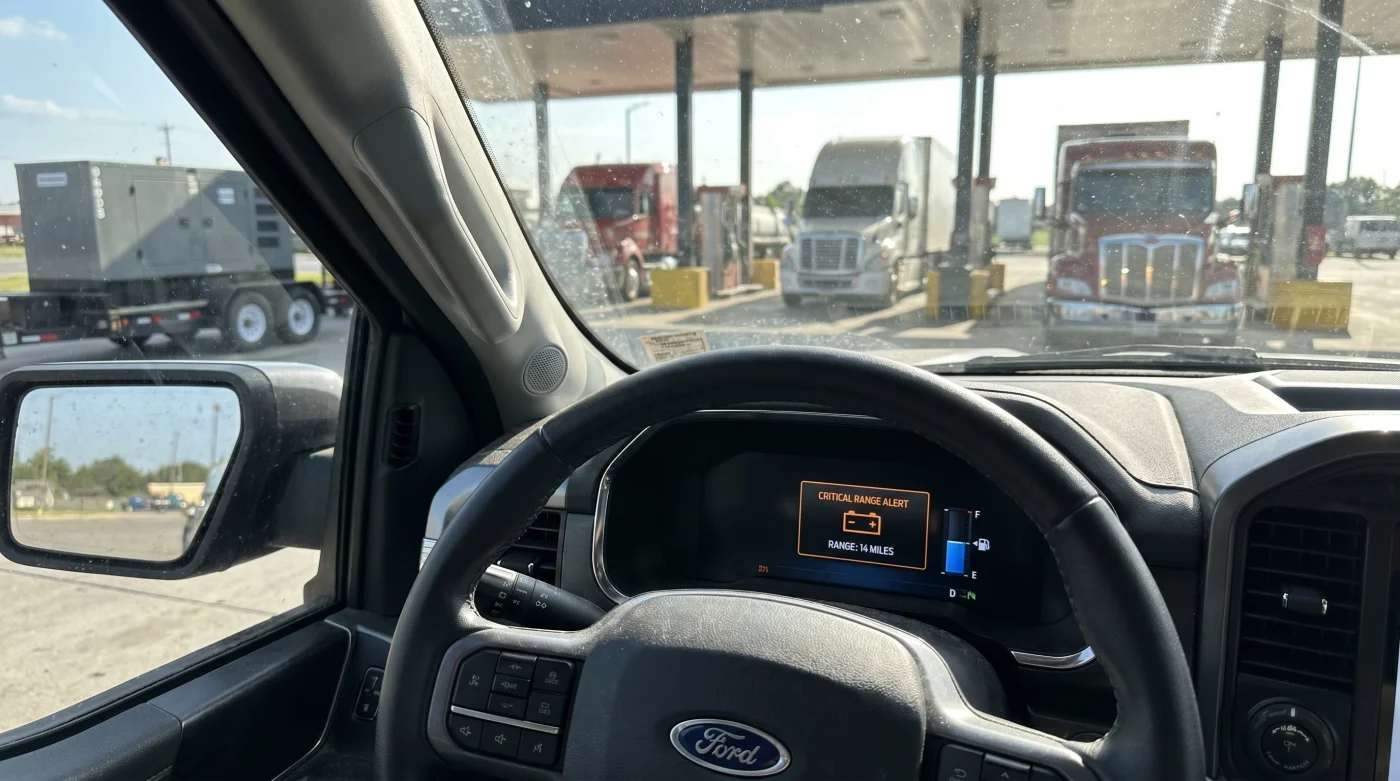
There is a specific kind of frustration that comes when the math of the boardroom fails to survive the friction of the job site. You were told these trucks would handle the daily grind, but as the first frost of autumn bites into the battery chemistry, the digital range readout begins to flicker with uncertainty. It is not just about the environment anymore; it is about whether or not your crew can make it back from a job site forty miles away without a flatbed tow. The shift is subtle but undeniable, as the initial wave of excitement for electrification hits the hard wall of physical physics.
Lately, the air in these fleet yards has changed, smelling less like ozone and more like the familiar, oily perfume of ultra-low sulfur diesel. Dealers who couldn’t keep a Lightning on the lot a year ago are now watching cancellations pile up like autumn leaves. This isn’t a rejection of technology; it is a return to predictable outcomes. When a deadline is looming and the payload is heavy, ‘predictable’ is the only word that matters to a man whose livelihood depends on a hitch and a four-way plug.
The Atmospheric Drag of the 160-Mile Cliff
To understand why fleet managers are turning their backs on the electric dream, you have to think about a long-distance runner trying to breathe through a thick pillow. In the world of internal combustion, a heavy load might drop your fuel economy by twenty percent, but you simply pull into any corner station and spend five minutes refilling the tank. With the Lightning, the physics are far more punishing. When you load a bed with gravel or hitch up a dual-axle trailer, the battery isn’t just working; it is screaming for its life. This is the ‘Towing Paradox’: the very tasks these trucks were built for are the ones that kill their utility the fastest.
Imagine your range as a bucket of water with a hole in the bottom. On a clear day with an empty bed, the leak is a slow drip. But add a 5,000-pound load and a headwind, and that drip becomes a gushing torrent. This isn’t a software bug or a minor inconvenience; it is a fundamental limitation of energy density. Commercial buyers are realizing that while an EV pickup is a masterpiece of engineering for a suburban commute, it often feels like a fragile instrument in a world that demands a sledgehammer. The pivot back to diesel isn’t a step backward; it’s a recalibration of what ‘work’ actually looks like in the American heartland.
- Ford stock surges as traditional gas fleet truck demand completely wipes out dealership inventories
- Toyota Tacoma ten-year maintenance proves port injection mechanics completely eliminate expensive carbon cleaning bills
- Ram 1500 air suspension mechanics expose severe winter freezing flaws the F-150 completely avoids
- Ford Bronco Sasquatch 40k-mile testing exposes extreme steering rack degradation over normal suburban potholes
- GM vehicle safety recall 2026 exposes a massive software flaw during early autonomous testing
Bill Henderson, a 54-year-old logistics director for a multi-state paving firm, was one of the first to jump on the Lightning pre-order list. He wanted to be the hero who saved the company sixty thousand dollars a year in gas. However, after three months of real-world testing, Bill shared a secret that is now echoing through the industry: when his crews loaded the trucks to 80% of their rated payload, the 300-mile range collapsed into a terrifying 120 miles. In the winter, that number dipped into double digits. Bill didn’t cancel his remaining forty orders because he hated the truck; he canceled them because he couldn’t afford to have his crews sitting at a Walmart charger for two hours in the middle of a shift.
The Three Pillars of the Diesel Resurgence
The market correction we are seeing isn’t a monolith; it’s a segmented retreat based on specific operational needs. Different types of workers are finding that the ‘one-size-fits-all’ electric promise doesn’t account for the variable chaos of labor. For the long-haul contractor, the diesel engine remains the only viable heartbeat for a truck that needs to cross three counties before noon. These are the buyers who value the ability to ‘fill and forget,’ knowing that their range stays consistent regardless of the weight in the bed.
Then you have the cold-weather specialist, the person working in the Dakotas or Maine, where the mercury spends months hiding below zero. For these users, an EV battery is a liability that requires constant nursing. They are returning to the PowerStroke diesel not for the prestige, but for the heater that works instantly and the battery that doesn’t lose a third of its capacity just by sitting overnight in a frozen driveway. The reliability of a diesel glow plug, once seen as old-fashioned, now feels like a warm security blanket in a world of high-voltage uncertainty.
Finally, there is the emergency responder and the utility repair crew. When the power goes out, you cannot rely on a vehicle that needs the grid to breathe. This irony isn’t lost on fleet managers who are now prioritizing mechanical autonomy over theoretical efficiency. They are looking for platforms that can idle for ten hours at a disaster site and still have the torque to pull a downed transformer through the mud. In these high-stakes scenarios, the diesel tank is more than a fuel source; it’s a survival kit that doesn’t require a software update to function.
The Tactical Toolkit for the Pragmatic Buyer
If you are currently weighing the decision between sticking with an EV order or pivoting back to a diesel platform like the F-250 or a heavy-duty RAM, you need to ignore the marketing brochures and look at the ’40/40 Rule.’ This is the metric that fleet veterans are now using to decide when to jump ship. If your typical daily payload exceeds 40% of the truck’s rated capacity, or if you operate in temperatures below 40 degrees Fahrenheit for more than three months a year, the electric range penalty becomes an operational tax you likely cannot afford to pay.
- Calculate the Energy Gap: Audit your longest route and subtract 55% of the advertised EV range to account for ‘bad day’ variables.
- Verify Charging Latency: Don’t look at ‘peak’ charging speeds; look at the 20% to 80% time in freezing weather.
- The 10-Year Residual: Diesel trucks currently hold 15-20% more value after 100k miles compared to aging battery platforms.
- Idle Time Costing: Diesel engines are more efficient at long-term idling for tool operation than most realize when compared to battery drain for cabin climate control.
When you sit in the cabin of a modern diesel, the vibration is no longer a nuisance; it is the steady pulse of capability. You aren’t checking a percentage bar every ten minutes; you are focused on the road ahead. This mindful shift back to ‘tool-first’ thinking is what’s driving the current inventory surplus of Lightnings. It is a realization that the most ‘sustainable’ vehicle is the one that actually completes the job without requiring a logistical miracle to keep it moving.
The Quiet Dignity of Proven Platforms
We are entering a period where the ‘new’ is being measured against the ‘necessary.’ The sudden surge in diesel demand isn’t a sign that innovation has failed; it is a sign that innovation hasn’t yet accounted for the brutality of the American work week. There is a quiet dignity in a machine that does exactly what it says it will do, every single time the key is turned. For the person responsible for a fleet of twenty trucks and forty employees, that certainty is worth more than any tax credit or environmental accolade.
Mastering this shift means understanding that your fleet’s peace of mind is the ultimate ROI. When you choose a platform that respects the physical limits of your environment, you reduce the mental load on your drivers and the financial strain on your back office. The diesel engine, once thought to be on its deathbed, has found a second life as the pragmatic alternative to a future that arrived a few years before the infrastructure was ready to support it. As you watch the market correct itself, remember that the best truck isn’t the one with the most screens—it’s the one that’s still moving when the sun goes down.
“The most expensive truck in your fleet is the one that is currently plugged into a wall while the crew is getting paid to wait.”
| Metric | F-150 Lightning (EV) | F-250/350 (Diesel) |
|---|---|---|
| Full Load Range | 100-130 Miles (Estimated) | 450-550 Miles (Consistent) |
| Refuel/Charge Time | 45-90 Minutes (DC Fast) | 5-8 Minutes (Any Station) |
| Cold Weather Impact | Up to 40% Loss | Minimal (with block heater) |
Is the Ford F-150 Lightning being discontinued for commercial use?
No, but Ford is significantly scaling back production and pivoting focus toward hybrid and diesel options to meet the actual demand patterns of fleet buyers who require higher range stability.Why are fleet managers specifically choosing diesel over gasoline?
Diesel offers superior torque for towing and significantly better fuel economy under heavy loads, which is where EV trucks currently struggle the most with range depletion.What was the exact range penalty that triggered the cancellations?
Commercial testing showed that towing a 5,000-lb trailer resulted in a 50-60% reduction in total driving range, making it impossible to complete standard regional routes without mid-day charging.Will charging infrastructure improvements fix this shift?
While infrastructure helps, the ‘time-at-plug’ remains a major labor cost. For commercial fleets, every hour spent charging is an hour of lost billable labor, which diesel avoids entirely.Are there any incentives left for keeping an EV fleet?
Federal tax credits remain, but many managers are finding that the operational losses from range anxiety and charging downtime far outweigh the initial tax savings.