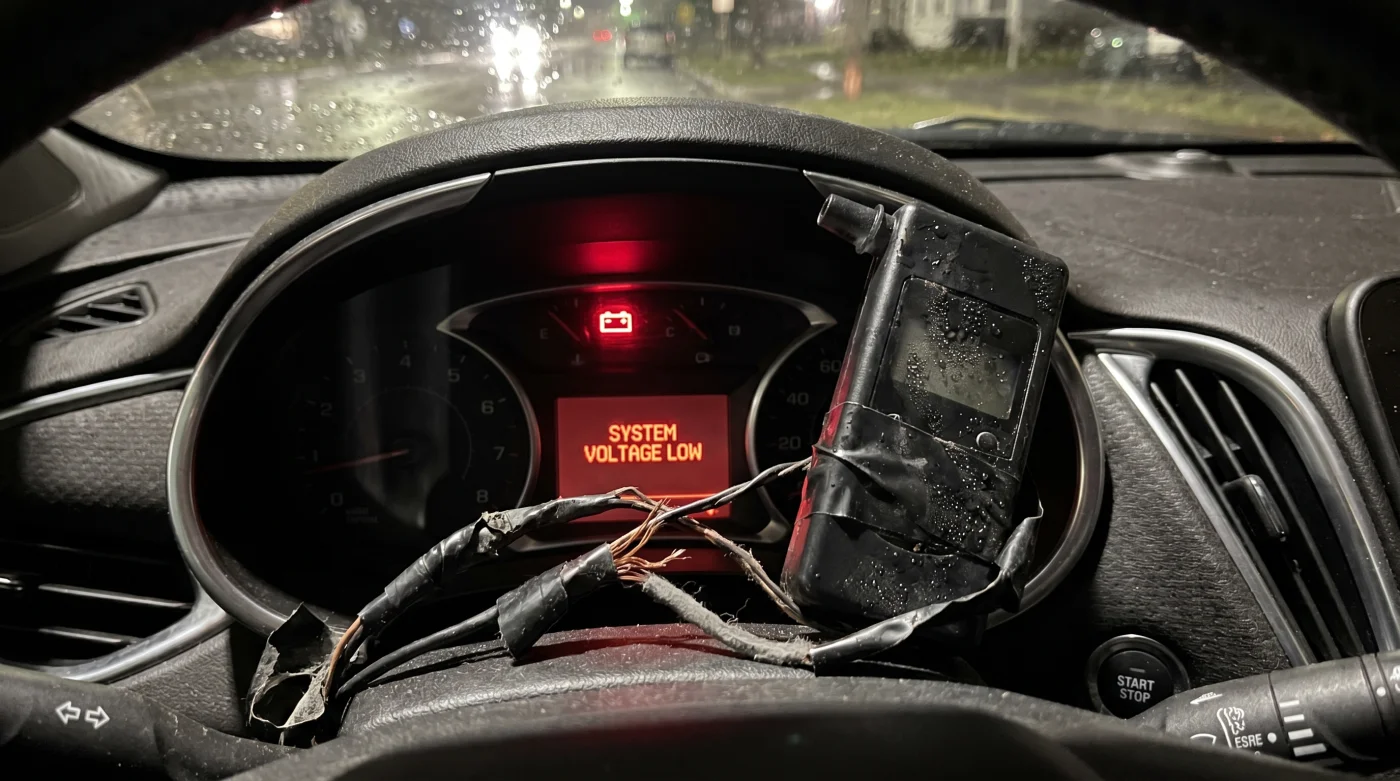
The interior of a late-model sedan at 3:00 AM smells faintly of stale coffee and the ozone-heavy scent of a hard-working heater. You turn the key, and instead of the confident roar of the engine, there is a sickly, rhythmic clicking—the sound of a machine trying to remember how to breathe. The dashboard lights pulse once, twice, then dim into a ghostly amber. It is the silence of a dead battery, but for those navigating the aftermath of a legal misstep, this silence is heavy with the threat of a technical violation. You look at the black box mounted to your dash, the ignition interlock device (BAIID), its small screen glowing with a mockery of readiness.
Most drivers assume the alternator died because of age or a fluke of manufacturing. But as the winter air seeps through the door seals, you notice a high-pitched, metallic whine coming from under the hood—a sound like a spinning top losing its balance. This is the sound of an alternator being ground down by an invisible weight. It isn’t just charging your battery anymore; it is fighting a constant, parasitic battle against a device that was never supposed to be part of the car’s original nervous system. When the legal world meets the mechanical world, the result is often a voltage drop that destroys the very heart of your vehicle’s electrical stability.
I have spent years watching the data streams of vehicles under duress, and the pattern is always the same. The alternator, designed to provide a steady flow of current, begins to shudder under the load of a poorly integrated interlock. These devices are often spliced into the primary ignition harness with the delicacy of a butcher’s knife. The result is a series of ‘dirty’ electrical signals that force the voltage regulator to work triple shifts, eventually cooking the internal diodes until they smell like scorched plastic and regret. You aren’t just paying for a legal mistake; you are paying for the slow erosion of your car’s reliability.
The Phantom Load Metaphor: Why Your Alternator Is Choking
Imagine trying to run a marathon while someone is intermittently pressing a wet pillow over your face. You can still breathe, but the effort required to draw every lungful of air doubles. This is exactly what a parasitic interlock splice does to your alternator. In a standard setup, the alternator feeds the battery and the car’s accessories in a predictable loop. However, when an interlock is ‘tapped’ into the main power line, it creates a secondary, unmetered draw. The alternator senses a drop in voltage and surges to compensate, but because the draw is constant—even when the car is off—the system never enters its natural state of rest.
- Chevy Tahoe direct injection neglect silently carbonizes intake valves ruining trade-in value
- Electric car 200k-mile longevity requires entirely skipping the factory recommended coolant flush schedule
- Tesla Model Y price change data exposes how auto brokers artificially inflate hidden delivery fees
- Chevy Silverado used buyers must inspect the thermal bypass valve for invisible micro-leaks
- Tesla Model Y price change exposes an artificial scarcity tactic used lots exploit
The secret lies in understanding that your car’s electrical system is a closed loop of trust. When a technician at a budget shop clips a wire to install a BAIID, they are breaking that circle of trust. They create a ‘bridge to nowhere’ where electricity leaks out into the device’s heater and sensor array. This causes the alternator to run at 100% capacity even during a casual drive to the grocery store. It’s not long before the bearings begin to tremble and the internal cooling fans can no longer keep up with the heat generated by the over-taxed copper windings.
To fix this, you must stop thinking about the interlock as an accessory and start treating it as a completely independent power grid. The goal isn’t just to keep the device running; it’s to hide its presence from the car’s sensitive Electronic Control Unit (ECU). By isolating the load, you allow the alternator to return to its rhythmic, low-stress operation, effectively silencing the phantom whine that signals an impending $800 repair bill.
The Attorney’s Discovery: Julian’s Dashcam Data
Julian Vance, a 52-year-old defense attorney in Chicago, didn’t set out to be a mechanic. He noticed a trend in his caseload: clients were being flagged for ‘power disconnects’—a violation of their probation—when they swore their cars simply wouldn’t start. Julian began reviewing high-resolution dashcam footage that included real-time OBD-II voltage overlays. What he saw was startling. Every time a client blew into the device, the system voltage plummeted from a healthy 14.2V to a staggering 11.8V for a split second. This wasn’t a battery issue; it was a demand spike that the alternator was failing to catch.
Segmenting the Strain: Tailoring the Fix to Your Drive
Not every car reacts to an interlock the same way, and your remedy should match your reality. If you drive a modern European car with a complex CAN-bus system, a simple splice is a death sentence for your alternator’s smart-regulator. For these vehicles, the fix involves a dedicated power-cleaner that smooths out the spikes. If you are a ‘For the Purist’ driver with an older domestic truck, you might need a heavy-duty alternator upgrade to handle the extra 15-amp surge the interlock’s fuel cell heater demands during cold starts.
For the ‘Occasional Driver’—someone whose car sits for three or four days at a time—the priority is the vampire drain. These drivers often find their batteries flattened because the interlock stays in a ‘sleep’ mode that is anything but restful. The solution here is a low-voltage disconnect relay that allows the interlock to function for its required reporting period but severs the connection before the battery’s core chemistry is compromised. This protects the alternator from the high-amperage ‘recovery charge’ it has to perform every time the car finally jumps to life.
Mindful Application: The T-Harness Bypass
Bypassing a messy installation doesn’t mean breaking the law; it means optimizing the physical connection. The most effective way to save your alternator without voiding your vehicle’s warranty is to move away from ‘vampire clips’ and toward a custom T-harness. This method allows the interlock to receive the signals it needs without ever physically cutting into the factory wires. It’s a cleaner, more stable bridge that preserves the integrity of the vehicle’s electrical resistance.
- Step 1: The Multimeter Audit. With the engine off, measure the draw at the interlock fuse. Anything over 50 milliamps during ‘sleep’ is a sign of a parasitic problem.
- Step 2: The Isolated Power Path. Run a dedicated, fused 10-gauge wire directly from the battery positive terminal to a high-current relay.
- Step 3: Triggering the Signal. Use the existing interlock power wire only as a ‘trigger’ for the relay. This ensures the device gets its 12V directly from the source, not through the crowded ignition loom.
- Step 4: Grounding Truths. Ensure the device is grounded to the chassis with a clean, unpainted bolt. Poor grounds cause 80% of the erratic voltage swings that kill alternators.
By implementing this Tactical Toolkit—using a 12V isolator, a dedicated fuse block, and dielectric grease on all connections—you create a barrier of protection. Your alternator no longer ‘sees’ the interlock as a massive, sudden load. Instead, the battery acts as a buffer, and the charging system can go back to its intended job of gentle replenishment. This is the ‘secret fix’ that professional installers rarely mention because it requires an extra twenty minutes of labor, but it’s the difference between a car that lasts and one that leaves you stranded.
The Bigger Picture: Reclaiming Your Mechanical Autonomy
Mastering the electrical health of your car during a period of legal oversight is more than just a maintenance task; it is an act of reclaiming control. When you are entangled with the court system, so much of your life feels like it belongs to someone else. Your schedule, your choices, even the air you breathe into a plastic tube are all monitored. By fixing the hidden voltage drop, you are ensuring that your physical mobility remains yours. You are refusing to let a temporary legal situation become a permanent mechanical failure.
There is a profound peace that comes from turning a key and hearing a crisp, immediate ignition. It is the sound of a system in balance. When your alternator runs cool and your battery stays full, you remove a layer of anxiety that shouldn’t be there. You realize that while the device may be a requirement, the destruction of your vehicle is not. By understanding the flow of current and the fragility of the alternator’s diodes, you move from being a victim of a bad installation to being the steward of your own machine.
“True mechanical reliability isn’t found in the absence of load, but in the precision of how that load is carried.”
| Key Point | Detail | Added Value for the Reader |
|---|---|---|
| Vampire Splice | Standard ‘tap’ into the ignition harness. | Causes high resistance and overheats the alternator. |
| T-Harness Isolation | Using a dedicated plug-and-play bridge. | Maintains factory warranty and stabilizes voltage. |
| Relay Buffering | Using the battery as a direct power source. | Protects sensitive ECUs from interlock-induced spikes. |
Can an interlock really kill a brand-new alternator? Yes, if the device’s heater pulls too much current through a high-resistance splice, the alternator’s voltage regulator will overheat and fail prematurely.
Will adding a second battery help? While it provides more capacity, it doesn’t solve the parasitic drain; a dedicated isolation relay is a more effective and lighter solution.
Does a ‘T-Harness’ bypass void my car’s warranty? Generally, no. Because it uses factory-style connectors without cutting wires, it falls under the protection of the Magnuson-Moss Warranty Act.
How do I know if my alternator is currently struggling? Listen for a high-pitched whine that changes with engine RPM or look for slightly flickering headlights while the interlock is ‘warming up.’
Is this fix legal? Absolutely. You are not tampering with the interlock’s ability to record or report; you are simply providing it with a cleaner, more stable power source.