The air in your suburban garage shouldn’t taste like singed copper or the sharp, acrid bite of melting insulation. Yet, for thousands of owners, that faint scent of ozone has become a haunting morning ritual. You step out into the driveway, cup of coffee in hand, half-expecting to see a wisp of gray smoke curling from the hood of your Elantra or Santa Fe. It’s a quiet dread, a parasitic anxiety that lingers long after you’ve clicked the lock button on your key fob and walked away.
For months, the official advice from the dealership has been as cold as a dead battery: park outside, keep it away from structures, and wait for a letter that may never arrive. They treat your vehicle like a volatile chemical spill rather than a machine you rely on to get your kids to soccer practice. You are told to wait for a specific part—a multi-fuse or a control module—that is currently sitting on a shipping container three thousand miles away. To the corporate office, your car is a line item in a liability spreadsheet, but to you, it is a potential fire hazard sitting beneath your master bedroom.
The standard dealer response is a script written by lawyers, not mechanics. They are bound by the rigid protocols of warranty reimbursement, which means they cannot—and will not—offer the simple mechanical bypass that solves the thermal runaway problem instantly. They want you to wait for the ‘official’ kit because that’s what keeps their franchise agreement intact. But the physics of electricity do not wait for paperwork, and neither should you when your property is at stake.
The Circuit Breaker Metaphor: Why Your HECU is Starving for a Sieve
Think of your car’s Anti-lock Brake System (ABS) module, specifically the Hydraulic Electronic Control Unit (HECU), as a high-pressure water main running into a house with old, brittle pipes. In many of these recalled models, an internal brake fluid leak can occur within the module. This fluid is conductive; it shouldn’t be, but under pressure and heat, it finds a way to bridge the gap between electrical contacts. When that happens, the current doesn’t just flow; it surges, like a river bursting through a rotted dam.
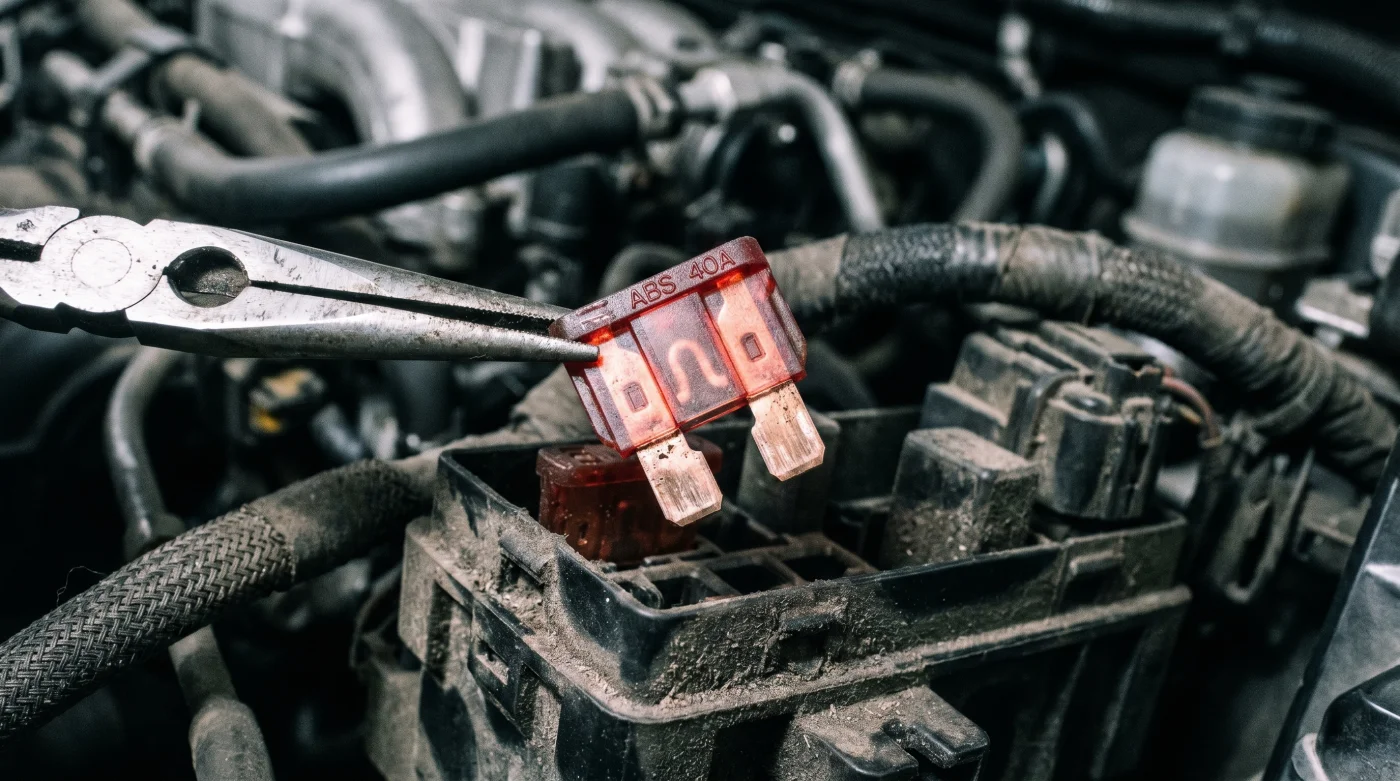
The ‘secret’ that dealers ignore is that the original fuse protecting this circuit is often rated much too high. It’s like having a heavy-duty industrial bolt where a delicate glass fuse should be. By the time the factory-spec 40-amp fuse finally decides to pop, the internal components have already reached temperatures high enough to ignite the plastic housing. You aren’t just dealing with a mechanical failure; you are dealing with an over-engineered path to thermal destruction that ignores the basic logic of electrical safety.
- NHTSA Honda rearview camera recall neglect silently destroys thousands in used vehicle resale
- Diesel fuel injection systems require this exact maintenance additive cycle to survive
- Carvana instant cash offers mask a predatory algorithm completely undervaluing specific premium suspension packages
- Cybertruck Wade Mode used inspections demand checking the battery pressure seal for failure
- Cybertruck Foundation Series secondary market prices collapse as reservation flippers flood dealership networks
Gus, a 62-year-old master electrician turned hobbyist mechanic in Cleveland, saw this flaw long before the first recall notices hit the mailboxes. He spent his afternoons troubleshooting a neighbor’s Tucson that kept draining its battery overnight. While the dealer suggested a new alternator, Gus noticed the HECU was warm to the touch even when the car had been off for six hours. ‘The module was humming,’ he told me. He didn’t wait for a factory part; he simply swapped the oversized fuse for a lower-rated 15-amp alternative. ‘If it shorts, it dies quietly,’ he said. ‘No fire, no drama, just a dead ABS light that tells you it’s time for a repair.’
Segmenting the Risk: The Three Tiers of Electrical Fatigue
For the **Daily Commuter**, the risk is most acute during the ‘cool down’ period. After a long drive, the residual engine heat can thin out brake fluid, making it easier for leaks to penetrate the electronics. If you fall into this camp, your primary focus should be the immediate reduction of the amperage ceiling in your engine-bay fuse box. You need the circuit to fail gracefully rather than burn brightly under the pressure of a commute.
For the **Long-Term Owner** with a vehicle over 100,000 miles, the seals within the HECU have likely already begun to degrade. In these older models, the bypass isn’t just a safety measure; it’s a diagnostic tool. If you install a lower-rated fuse and it pops within a week, you have caught a fire in its infancy. You’ve successfully forced the system to tell you it’s failing before it has the chance to melt your wire harness.
For the **Parked and Waiting** crowd—those who have been told by dealers that parts are six months out—the bypass is your ticket back into your own garage. You don’t have to leave your pride and joy out in the rain or snow, vulnerable to catalytic converter thieves or the elements. By restricting the potential energy available to the faulty module, you effectively ‘neutrals’ the threat while maintaining the vehicle’s basic operability.
The Tactical Toolkit: A Mindful Approach to the Fuse Bypass
Taking control of your vehicle’s safety is a deliberate process. It requires you to step away from the panic of the headlines and look at the physical reality of your fuse box. This is a five-minute intervention that costs less than a cup of coffee but provides a buffer of safety that the dealership is legally prohibited from suggesting.
- Identify the HECU/ABS fuse in the primary engine-bay fuse block (refer to the diagram on the underside of the plastic lid).
- Verify the original rating; most affected models utilize a large 40A or 50A ‘J-Case’ or ‘Multi-fuse’ block.
- Source a lower-rated replacement fuse—typically 15A or 20A—that matches the physical footprint of the original.
- Ensure the ignition is off and the battery is disconnected before swapping the components to avoid any momentary arcing.
The logic here is beautifully simple: a 15-amp fuse will blow the moment a micro-short occurs due to fluid ingress. The 40-amp factory fuse is strong enough to allow the short to fester, generating hundreds of degrees of localized heat before it finally breaks the circuit. You are essentially installing a ‘shorter fuse’ on a metaphorical bomb, ensuring that if anything goes wrong, the lights go out before the fire starts.
The Bigger Picture: Reclaiming Your Mechanical Sovereignty
We live in an era where vehicles have become black boxes, proprietary systems that we are told we cannot understand or touch. This recall crisis highlights the danger of that mindset. When you rely solely on a corporate entity to manage your personal safety through a supply chain, you become a victim of their logistics. By understanding the electrical ‘why’ behind the fire risk, you move from a state of passive fear to one of active management.
Mastering this small detail—this simple fuse bypass—isn’t just about saving your garage from a potential fire. It’s about the peace of mind that comes from knowing you aren’t helpless. It is the quiet satisfaction of looking at your car and knowing that, even while the ‘experts’ are stuck in a cycle of backordered parts and bureaucratic delays, you have taken the necessary steps to protect your home. You’ve silenced the hum, cleared the ozone from the air, and regained your sleep.