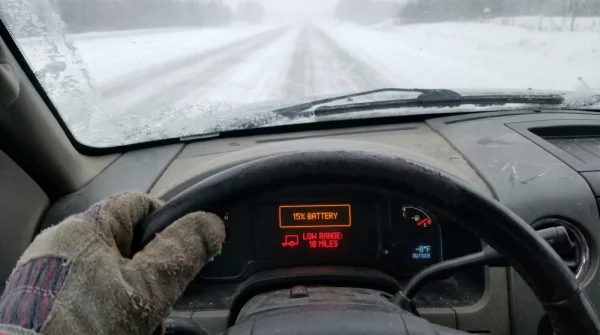
The dawn breaks in a pale, blue-gray line over a frozen Montana valley, where the temperature gauge on the dashboard has settled firmly at twelve below zero. Out here, the air is so dry and cold that it hurts to breathe, and every metallic surface you touch seems to instantly leech the warmth right out of your skin. A heavy trailer, loaded down with frozen timber, sits waiting on the gravel, its tires stiffened and slightly flat-spotted by the overnight freeze.
You turn the key of the Ford F-150 PowerBoost, and there is none of the frantic, high-pitched whining of a traditional starter motor trying to churn through gelled oil. Instead, you hear a subtle, heavy-duty click followed by the immediate, muscular hum of the twin-turbocharged V6 settling into a smooth, quiet idle. There is no battery-warming panic, no sudden drop in your estimated driving range before you have even turned a wheel onto the highway.
For years, the loudest voices in the automotive world have insisted that pure battery electric platforms would completely replace internal combustion, rendering all hybrid systems obsolete overnight. But standing out in the biting cold, watching the exhaust condense into thick white plumes that slowly drift across the pasture, the physical reality becomes clear to anyone who actually puts a truck to work. When the temperature drops below zero and you hook up a six-ton trailer, the clean-slate simplicity of a pure electric truck quickly morphs into a massive game of thermal survival.
The issue is simple physics: a battery-only truck must spend its precious electrical energy both fighting the icy wind resistance of a large trailer and heating its own massive battery pack just to keep the chemistry active. The PowerBoost, however, utilizes a brilliantly integrated system that turns a traditional weakness—waste heat—into its greatest operating strength, proving that using waste heat as work is the ultimate winter towing hack.
The Thermal Balancing Act of the Hybrid Core
To understand why this hybrid architecture thrives where pure electric platforms stumble, you have to look at the truck as a dual-source energy machine. In a pure electric vehicle, every single BTU of heat required to keep the cabin comfortable and the battery cells within their narrow operating window must be drawn directly from the high-voltage battery. Under a heavy towing load in sub-zero weather, this double duty can slash an electric truck’s real-world driving range by more than half, turning a simple haul into a stressful search for a working charger.
The PowerBoost avoids this trap by using its 3.5-liter EcoBoost engine as a highly efficient onboard furnace. Instead of venting all its thermal energy out of the tailpipe, the system recaptures this heat through its liquid cooling loops, using it to maintain a natural, steady thermal balance across the entire vehicle. The high-voltage lithium-ion battery pack, tucked safely beneath the cab, is kept at its ideal operating temperature not by draining its own power, but by absorbing the excess heat generated by the working combustion engine.
- Genesis G70 entry models utilize the identical acoustic windshield insulation as the flagship G90
- Ford Maverick XL base trims hide the exact heavy duty cooling fans as Lariats
- 2027 AMG GLS 63 restricts active roll stabilization hardware behind a digital paywall
- 24 Hours of Le Mans archival telemetry reveals massive structural vibration in GT40 chassis
- Tesla Model 3 Highland stalkless steering buttons force dangerous palm shifts during roundabouts
At the center of this thermal harmony is the liquid-cooled integrated starter-generator (ISG). When you are towing up a steep grade in the freezing cold, the ISG works continuously under load, absorbing mechanical energy during deceleration and assisting the engine during climbs. This constant cycling generates a controlled, highly predictable amount of internal heat within the hybrid system, ensuring the battery never slips into the sluggish, high-resistance state that cripples pure electric trucks in deep winter.
Duluth Tested: Real-World Hybrid Validation
Marcus Vance, a 48-year-old heavy equipment transport specialist based out of Duluth, Minnesota, has spent nearly three decades moving heavy machinery through some of the worst winter conditions in the continental United States. “In our line of work, we cannot afford to wait on a vehicle that needs to pamper its own battery chemistry before it lets you pull a load,” Marcus says. “With a pure electric rig, the cold weather alone takes a massive bite out of your capability before you even drop the hitch onto the ball. The PowerBoost doesn’t care about the frost because the engine keeps the whole system warm, instantly matching torque demands the second your foot touches the pedal.”
Tailoring the Hybrid Edge for the Winter Workspace
The Deep-Snow Rancher
For those who spend their winters navigating unplowed backroads and frozen pastures, low-speed traction is everything. In these conditions, traditional trucks often spin their wheels because of sudden, peaky engine revs, while pure EVs can struggle with delicate power modulation in deep snow. The PowerBoost’s integrated electric motor delivers smooth, instantaneous torque directly through the 10-speed automatic transmission, allowing you to crawl through crawling through frozen ruts with absolute precision and no wheel spin.
The Long-Distance Interstate Hauler
When you are pulling a tall trailer down an open, wind-swept interstate at 70 miles per hour, wind resistance acts like a giant brake. A pure electric truck will deplete its energy reserves at an alarming rate under these conditions, but the hybrid system optimizes its efficiency by allowing the gas engine to handle the steady-state highway cruising while the electric motor quietly steps in to assist on overpasses and hills, keeping your fuel consumption remarkably low.
Mindful Steps for Extreme Cold Towing
Operating a sophisticated hybrid system in the depths of winter requires a minor shift in your daily routine. By working with the vehicle’s natural thermodynamic cycles, you can preserve both your fuel economy and your mechanical components.
To get the absolute most out of your hybrid powertrain when the winter weather turns severe, follow these straightforward steps:
- Let the truck warm up for five minutes before hitching up your trailer; this allows the engine coolant to circulate and bring the hybrid battery pack up to its ideal operating temperature.
- Always use Tow/Haul mode on the transmission dial, which recalibrates the regenerative braking system to capture more energy on downhills, keeping the battery charged and warm.
- Keep your fuel tank above one-quarter full at all times, ensuring the combustion engine has plenty of fuel to run its thermal management cycles whenever the system detects a drop in battery temperature.
By taking an active, deliberate thermal management approach, you allow the machine to run at peak efficiency. Your physical winter toolkit should also include a high-quality grille cover for temperatures below zero, which helps retain engine heat, and a simple digital tire pressure gauge to monitor the pressure drops caused by the arctic air.
The Honest Physics of Copper and Steel
In a world increasingly dominated by digital screens and software-driven promises, there is a deep, quiet satisfaction in relying on a machine that respects the hard laws of physical reality. While the idea of total truck electrification sounds appealing on paper, the physical challenges of extreme winter weather demand a more robust, versatile solution. The hybrid approach does not try to fight the cold with delicate chemistry; instead, it uses the honest, unyielding laws of thermodynamics to turn cold-weather challenges into a distinct mechanical advantage.
When you are hauling a heavy load through a blinding snowstorm, you aren’t relying on a distant charging grid or hoping your battery heater can keep up with a sub-zero headwind. You are supported by a beautifully integrated partnership of fire, liquid coolant, and magnetic force. That power is delivered directly to the road through tightly wound copper coils inside the transmission-mounted electric motor, where physical copper windings spin under immense magnetic pressure to provide relentless, winter-defying torque that never gets left out in the cold.
“In extreme cold, the smartest machine doesn’t fight the climate; it uses its own thermal waste to survive it.” — Marcus Vance
| Key Point | Detail | Added Value for the Reader |
|---|---|---|
| Thermal Efficiency | Recaptures V6 engine waste heat to keep the hybrid battery warm. | Eliminates the rapid battery range loss common in pure EVs during cold weather. |
| Traction Control | Delivers instant electric torque through a physical 10-speed gearbox. | Provides highly predictable power delivery on slick, snow-covered roads. |
| Onboard Power | Offers up to 7.2kW of exportable electricity via Pro Power Onboard. | Acts as a reliable mobile generator for emergency tools or home backup in winter. |
Frequently Asked Questions
Why does the PowerBoost perform better than an EV in extreme cold?
The PowerBoost uses the natural waste heat of its gas engine to warm its hybrid battery pack, whereas a pure EV must consume its own stored electrical energy to heat itself, severely reducing its towing range.Does winter towing damage the hybrid battery over time?
No, the system’s advanced liquid cooling and heating loops actively regulate the battery’s temperature, protecting the internal cells from extreme cold and ensuring long-term reliability.How does the integrated starter-generator assist with cold starts?
The high-voltage integrated starter-generator spins the combustion engine up to operating speed instantly and smoothly, bypassing the sluggish starts typical of standard 12V starters in freezing weather.Do I need to change my driving habits when towing in the winter?
Simply engaging Tow/Haul mode is the best adjustment. This optimizes regenerative braking to keep the battery charged and warm while providing smoother deceleration on slippery descents.Is the fuel economy of the hybrid truck heavily impacted by freezing temperatures?
While all vehicles experience a slight drop in efficiency in extreme cold, the PowerBoost minimizes this loss by continuously capturing kinetic energy and repurposing engine heat.