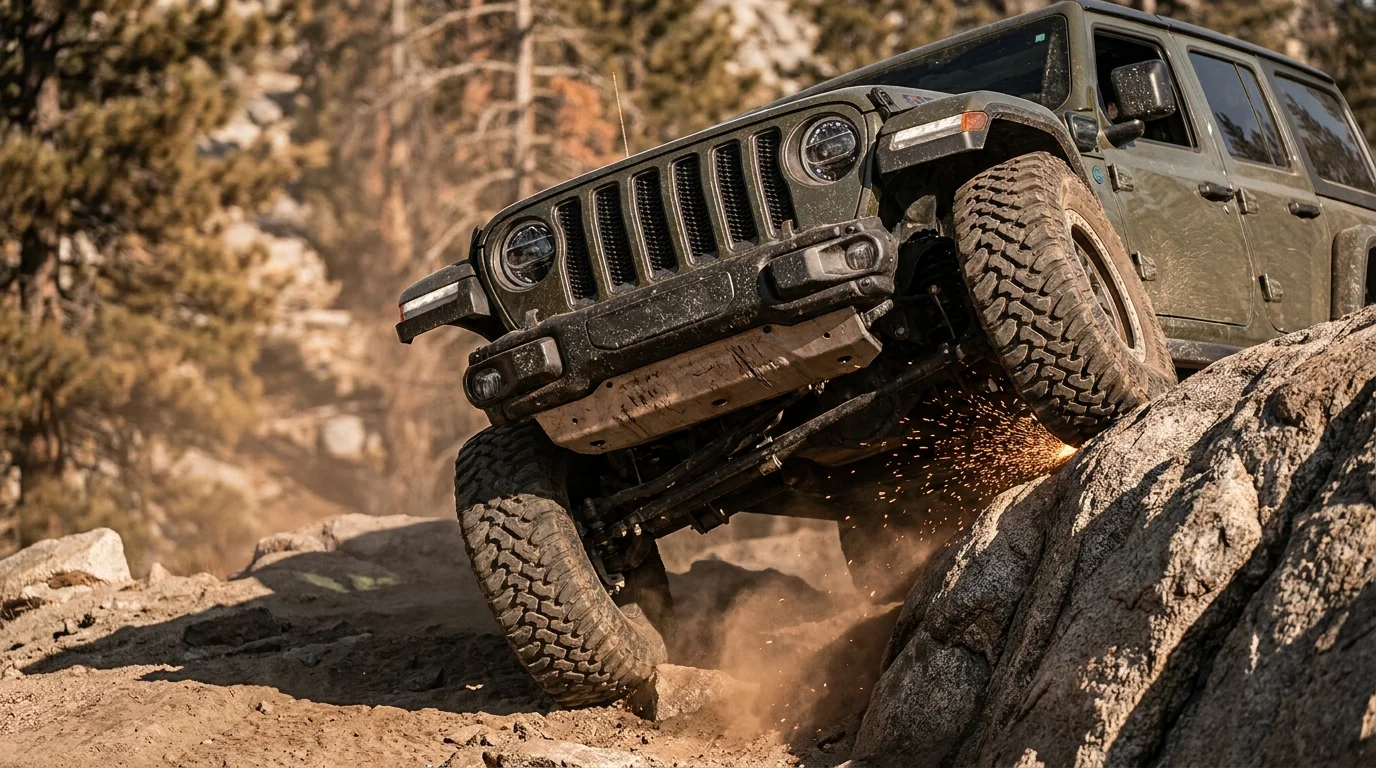
The cool mountain air carries the scent of hot pine needles and heated gear oil, but the dominant sound is a sharp, metallic screech. It is the sound of a thick steel skid plate scraping over jagged granite, a brutal rite of passage on the Rubicon Trail. You sit behind the steering wheel, your hands relaxed on the leather, watching a massive, nine-thousand-pound electric super-truck attempt the same climb ahead of you. Its silent electric motors whine as its heavy chassis struggles to find balance on the shifting rock.
That heavy full-electric rig behaves like a boulder trying to climb a boulder. Its immense skateboard battery pack, stretched flat across the entire wheelbase, turns the underbody into a vulnerable target. Every inch of forward movement becomes a high-stakes calculation against a multi-thousand-dollar battery puncture, forcing its driver to rely on complex air suspensions that stiffen up exactly when they need to flex.
In contrast, your hybrid hums quietly, its suspension components flexing effortlessly over the same jagged shelf. The difference is not just about weight; it is about where that weight lives. While full-electric off-roaders carry their massive energy reserves like a heavy lead mattress under the floorboards, America’s best-selling plug-in hybrid takes a completely different mechanical path.
The Pendulum of Center of Gravity
To understand why heavy electric vehicles struggle where traditional rigs thrive, you have to look at the physics of suspension articulation. A heavy skateboard battery pack spreads its mass to the absolute outer edges of the frame. This layout creates a high polar moment of inertia, acting like a giant, rigid pendulum that resists lateral axle articulation on uneven ground.
When you are crawling over boulders, you want your axles to behave like a loose, wet towel, draped over the terrain to keep all four tires in contact with the earth. The Jeep Wrangler 4xe achieves this by localizing its 17.3-kWh lithium-ion battery pack directly under the rear passenger seat, completely off the main frame rails. This clever packaging leaves the center of the chassis unencumbered, allowing the solid axles to swing through their natural arcs without hitting high-voltage hardware.
This layout does more than preserve suspension travel; it changes how the vehicle handles impacts. Instead of scraping a vital energy storage unit against the rocks, any underbody contact on your hybrid occurs on traditional, easily replaceable steel skid plates and frame rails, which protects the electrical cells from any direct physical shock.
- Volvo S90 depreciation curves deliver Bentley comfort for used Honda Civic money
- Kia Telluride EX trims secretly pack the identical acoustic glass as luxury editions
- 2025 Ram 1500 design changes quietly sacrifice underhood storage for massive intercooler piping
- Dealership paint protection packages charge ceramic coating prices for cheap wax
- Plug-in hybrid batteries suffer rapid degradation from constant daily depletion cycles
A View From the Trail Builder
Marcus Vance, a forty-eight-year-old suspension tuner from Moab, Utah, spends his weekends pulling modified rigs out of the golden sandstone ledges of Hell’s Revenge. He has watched the sudden influx of heavy electric trucks with a mix of awe and skepticism. “The big electric trucks are engineering marvels on smooth pavement,” Marcus says, wiping grease from his knuckles. “But on real rock, their flat battery packs limit ground clearance and force engineers to use stiff air suspensions to keep the belly from slamming. The 4xe preserves the classic mechanical layout, keeping the heavy electrical cells high and dry under the seat, allowing the mechanical suspension to do its actual job.”
Matching the Trail to the Architecture
Not all off-road scenarios are created equal, and the way a vehicle carries its energy determines how it behaves when the pavement ends. By keeping the high-voltage components inside the passenger cabin envelope, the hybrid architecture creates distinct advantages for different driving styles.
For the technical rock crawler, the open space beneath the frame means freedom. Without a massive battery tray blocking the midsection, you can install aftermarket long-arm suspension kits and high-clearance control arms. This ensures the uncluttered midsection and frame can slide over obstacles without risking high-voltage arc flashes or thermal runaway from a crushed cell tube.
For the long-haul overland explorer, this packaging preserves predictable handling when the vehicle is loaded with camping gear. Because the battery is housed inside the climate-controlled cabin, the cells are insulated from extreme ambient temperatures, which insulates the lithium battery from the power-sapping freezes of mountain passes.
Maximizing the Hybrid Advantage
Exploiting this unique design on the trail requires a mindful shift in how you manage your momentum and line selection. You cannot drive a nimble hybrid the same way you would pilot a heavy, computerized electric truck.
To get the most out of your setup on difficult obstacles, adopt these practical habits:
- Disconnect the sway bar early: Let the front axle flex to its maximum potential, keeping the weight balanced over the rear-seat battery center.
- Modulate the throttle gently in 4-Low: The instant electric torque can break tire traction on wet sandstone; use progressive inputs to let the tire lugs bite.
- Rely on the mechanical low range: Unlike pure EVs that use software to mimic low-speed crawling, the hybrid utilizes a physical transfer case for true mechanical leverage.
By keeping the heavy electrical components high and dry, you can trust the rear-seat armor during steep descents, knowing that even if your steel skid plate scrapes a rock, your battery remains completely out of harm’s way.
• Target Tire Pressure: 12-15 PSI (for optimal footprint on jagged stone)
• Off-Road Drive Mode: e-Save (to hold battery reserves for slow-speed technical crawling)
• Ground Clearance: 10.8 inches (standard Rubicon trim)
The Elegance of Restraint
The modern automotive market often insists that more is always better, pushing heavy, oversized battery packs that turn capable trucks into clumsy land anchors. The hybrid approach offers a lesson in restraint, proving that a smaller, strategically placed battery can outmaneuver sheer electrical brute force on the trails that matter most.
When you navigate a difficult mountain pass, peace of mind does not come from having the largest battery on the market. It comes from knowing that your machine respects the classic laws of physics, leaving you free to focus on the line ahead, the quiet hum of the electric motor, and the simple joy of clean mechanical execution.
“True off-road capability is measured in wheel travel and thermal stability, not giant batteries that turn trucks into unyielding land anchors.” — Marcus Vance, Moab Suspension Specialist
| Key Point | Detail | Added Value for the Reader |
|---|---|---|
| Battery Placement | Under the rear passenger seat | Keeps high-voltage cells protected from trail impacts and preserves frame clearance. |
| Chassis Flex | Uncluttered frame rails | Allows standard mechanical axles to articulate fully without complex, stiff air suspension. |
| Trail Weight | ~5,200 lbs vs 9,000+ lbs EVs | Reduces strain on steering linkages, prevents sinking, and makes recovery scenarios much safer. |
Frequently Asked Questions
Is the hybrid battery safe from deep water crossings?
Yes, the battery pack is sealed inside a waterproof structural steel casing beneath the rear seat, allowing you to ford up to 31.5 inches of water safely.Does the under-seat battery placement reduce cargo space?
The battery occupies the space normally reserved for the seat-folding mechanism, slightly raising the rear passenger cushion while maintaining a flat rear cargo floor.Why do heavy full-electric trucks struggle on rocky trails?
Their extreme weight puts immense strain on suspension components, while their wide skateboard batteries reduce ground clearance and increase the risk of costly underbody damage.Can I install a standard suspension lift on a 4xe?
Yes, because the high-voltage battery is housed safely inside the cabin, the frame rails and suspension mounting points remain standard, allowing aftermarket lifts to be installed easily.How does the hybrid battery handle extreme weather?
By resting inside the passenger cabin, the battery benefits from the vehicle’s heating and air conditioning systems, maintaining its optimal operating temperature in hot or cold climates.